
Table of Contents
The catalase test procedure identifies bacteria that produce the catalase enzyme. The enzyme is present in nearly all organisms and, when exposed to oxygen, catalyzes the breakdown of hydrogen peroxide to oxygen and water.
Bacteria that utilize aerobic respiration produce H2O2 as a toxic byproduct. They make the catalase enzyme a virulence factor to neutralize the antibacterial/ oxidative effect of the by-product.
Obligate anaerobes lack the enzyme and cannot survive in the presence of oxygen; however, some species have adopted other measures to survive. Microbiologists use the test in bacteria identification, which helps them narrow down on bacteria based on their ability to produce the enzyme. In most settings, they use the test to determine whether a gram-positive cocci is a streptococcus (negative) or a staphylococcus (positive).
Commercial hydrogen peroxide is a mild antiseptic applied to broken skin to prevent infection—the fizzing effect results from forming oxygen gas after its application.
Microbiologists and laboratory technicians often use this test alongside the coagulase test.
Catalase test principle

The catalase enzyme is a protein that speeds up chemical reactions; when produced by bacteria, it catalyzes the decomposition of hydrogen peroxide H2O2 into water H20 and Oxygen O2.
The production of oxygen gas produces a fizzing/ bubbling effect.
The optimum temperature and pH for the catalase enzyme are 37oC and 7.0, respectively. The enzyme is inactive at a pH higher than 11 or lower than 7.0.
Temperature affects the enzyme’s structure and the test’s efficacy; as the temperature rises from 0oC, the hydrogen bonds become weak and are easily cleaved, while the enzyme becomes more active. However, as the temperature rises above the optimum 30oC to 40oC, the enzyme becomes inactive and denatures.
Test guidelines and precautions
Test bacterial colonies should not be grown on blood agar because it contains the catalase enzyme, which it uses to decompose hydrogen peroxide produced by red blood cells.
Some bacteria species produce the enzyme peroxidase that breaks down hydrogen peroxide but is less intensive. Decomposition by the enzyme is slow and produces fewer bubbles during testing. Do not report the weakly positive result as catalase positive.
Ensure you conduct the test in a sterile environment and with the proper personal protective equipment.
DO NOT use an iron loop. Iron will react with the reagent resulting in a false positive result.
The test colony should be at most 18 hours old; for anaerobes, expose the colony to air for 30 minutes before testing.
Test requirements include a glass slide, test tube, 3% hydrogen peroxide (15% if you used anaerobic conditions), glass rod/ wooden applicator stick, and the test bacteria colony.
Catalase test procedure
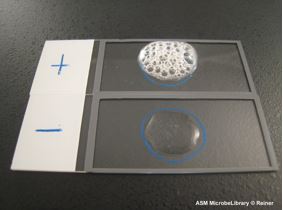
Slide test
- Place a sterile glass slide on a horizontal surface.
- Pick a bacteria colony using the glass rod and smear it on the slide.
- Place a drop of hydrogen peroxide on top of the smear.
- Immediately check for fizzing and production of bubbles.
- If present, report as catalase positive; else, report catalase negative.
Tube test
- Put 2 ml of H2O2 solution into a test tube.
- Pick a few colonies of the test bacteria and immerse them in the solution
- Immediately check for fizzing or production of bubbles.
- If present, report as catalase positive; else, report catalase negative.

Catalase positive bacteria
Examples of catalase-positive bacteria are the family Enterobacteriaceae (Shigella, Yersinia, Citrobacter, Escherichia coli, Salmonella, Proteus), Corynebacterium diphtheriae, Burkholderia cepacia, Mycobacterium tuberculosis, and Rhodococcus equi.
Catalase negative bacteria
Examples of catalase-negative bacteria are the species Enterococcus and streptococcus.
